


Flying with Dogs: The Ultimate Stress-Free Travel Guide
You’ve finally booked the tickets for that long-awaited trip. The suitcases are zipped, the itinerary is set… and now you’re looking at the dog carrier sitting by the door. Your usually confident pup keeps giving it side-eye, and you’re wondering how on earth you’re going to get through airport security, possible delays, and the actual flight without your dog (or you) melting down. That mix of excitement and quiet dread is incredibly common for first-time pet flyers. The good news? With the right preparation, flying with dogs doesn’t have to be a nightmare. This guide walks you through the realities of airline pet policies, practical preparation steps, and real-world strategies that have helped many owners and their dogs travel smoothly.
Why Flying with Your Dog Feels Overwhelming
Rules change between airlines and routes. Your dog’s comfort and safety depend on factors you can’t fully control, like cabin pressure, temperature in the hold, or how busy the airport is that day. Add in the emotional weight of wanting to protect a family member who can’t tell you how they’re feeling, and it’s no wonder many people postpone or avoid flying with their pets altogether.
This guide cuts through the noise. We focus on the patterns that actually matter across most airlines, realistic timelines for preparation, and the small but powerful steps that reduce stress for both of you. Whether you’re heading across the country or across an ocean, the same core principles apply: know your options, prepare your dog in advance, and build in buffers for the unexpected.
Cabin or Cargo? Deciding What’s Right for Your Dog
Most airlines offer two main options for traveling dogs: in the cabin with you or as cargo in the pressurized baggage hold.
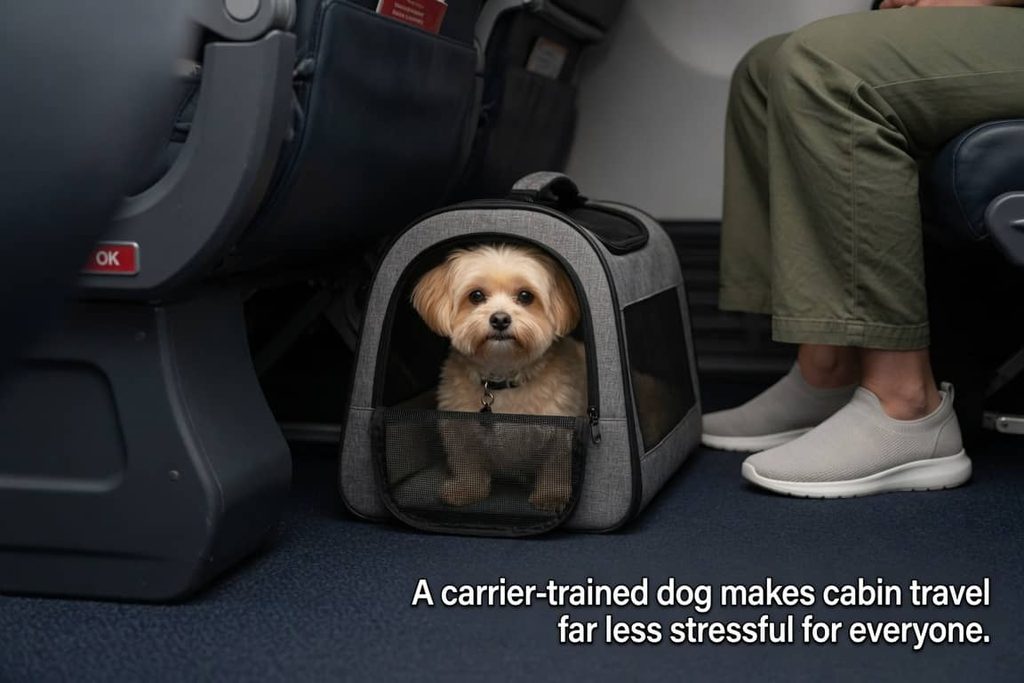
Cabin travel is generally limited to smaller dogs that can comfortably stand, turn around, and lie down inside a carrier that fits completely under the seat in front of you. It keeps your dog close, lets you monitor them throughout the flight, and usually involves less handling by airline staff. However, space is tight, and not every dog tolerates prolonged confinement in a small carrier.
Cargo travel accommodates larger dogs or those who exceed cabin size limits. The dog rides in a sturdy, airline-approved crate in a temperature-controlled section of the hold. While modern cargo holds are pressurized and ventilated, your dog will be out of your direct sight for the duration of the flight (and any ground time). Some airlines have limited or no cargo pet service on certain routes or aircraft.
How to decide: Start with your dog’s size and breed. Then consider temperament. A calm, crate-trained dog who enjoys den-like spaces often does well in cargo. A dog who panics when separated or has never spent time in a crate may do better in cabin if size allows. Direct flights are almost always preferable to connections when traveling with pets, regardless of cabin or cargo, because every transfer adds handling and potential delays.
If you have a brachycephalic (flat-faced) breed such as a pug, bulldog, or boxer, pay special attention. Many airlines restrict or prohibit these dogs from cargo travel, especially during warmer months, due to breathing and temperature-regulation challenges. In some cases, cabin may be your only realistic option or you may need to explore specialized pet transport services. Always confirm current rules for your exact itinerary rather than assuming based on past trips or other airlines.
How Airline Pet Policies Generally Work
While every airline sets its own details, several patterns appear consistently. Carriers must typically be leak-proof, well-ventilated on at least three sides, and sturdy enough that they won’t collapse if something is placed on top (especially important for cargo). Soft-sided carriers are popular for cabin travel because they can be slightly compressed to fit under seats, but they still need a rigid frame or base in most cases.
Fees vary widely and are usually charged per pet, per direction. Cargo fees are almost always higher than cabin fees and may involve additional charges for oversized crates or special handling. Some airlines limit the number of pets allowed in cabin per flight or per passenger.
Breed restrictions are one of the biggest variables. Beyond brachycephalic dogs, some carriers have age minimums (commonly around eight weeks) and may refuse very young puppies or senior dogs with certain health conditions. International travel adds layers: most countries require a veterinary health certificate, proof of rabies vaccination, and increasingly a microchip. Some destinations demand additional titers, import permits, or even quarantine periods. These rules are set by the destination country, not the airline, so you must check both.
The single most important action you can take is to verify everything directly with your airline (and the destination government’s agriculture or veterinary authority) for your specific travel dates and route. Policies shift with regulations, aircraft changes, and seasonal considerations, so what was true last year may not be true now.
Airline Pet Policy Comparison: Emirates vs Qatar Airways vs Turkish Airlines
Emirates
- Cabin allowed: No (falcons only, select Dubai–Pakistan routes)
- Checked baggage/Hold: Yes, up to 300 cm total dimensions
- Cargo required when: Over 32 kg or 300 cm
- Estimated cost: Approx. $500–$800
- Breed restrictions: Brachycephalic breeds banned (Bulldogs, Pugs, Persian cats)
- Advance booking: 48–72 hours minimum
- Minimum pet age: 15 weeks
- Temperature limit: No travel above 29°C (85°F)
- Official page: emirates.com
Qatar Airways
- Cabin allowed: No (falcons and service dogs only)
- Checked baggage/Hold: Yes, up to 75 kg combined weight
- Cargo required when: Over 75 kg or 300 cm
- Estimated cost: Approx. $200–$450
- Breed restrictions: Brachycephalic and several breeds banned (Pugs, Bulldogs, Boxers, Pit Bulls)
- Documentation: Health certificate (within 10 days), vaccination records, microchip/passport
- Advance booking: At least 48 hours
- Minimum pet age: 12 weeks
- Temperature limit: Restricted above 21°C (69.8°F)
- Official page: qatarairways.com
Turkish Airlines
- Cabin allowed: Yes — cats, dogs & small birds up to 8 kg combined weight
- Checked baggage/Hold: Yes, up to 50 kg (carrier max 75×75×125 cm)
- Cargo required when: Over 50 kg or restricted breed
- Estimated cost: From $70 (cabin, intl) to $120+ (checked baggage, intl
- Breed restrictions: Large guard breeds cargo-only (Rottweiler, Doberman); brachycephalic breeds cabin-only
- Documentation: Health certificate (within 10 days), vaccination records, microchip/passport
- Advance booking: Up to 24 hours before, but earlier recommended
- Minimum pet age: 10 weeks
- Temperature limit: Cargo suspended above 29°C or below 7°C (May–Sept)
- Official page: turkishairlines.com

Getting Ready: Your Pre-Flight Preparation Plan
Good preparation starts two to three weeks before departure and makes the biggest difference in how your dog experiences travel day.
Carrier acclimation is non-negotiable. If your dog only sees the carrier on the morning of the flight, expect stress. Begin by leaving the carrier open in a high-traffic area of your home with a favorite blanket and treats scattered inside. Once your dog voluntarily enters, start feeding meals in the carrier. Progress to closing the door for short periods while you’re in the same room, then while you step out briefly. Add short car rides with the carrier secured. The goal is to build a positive association so the carrier feels like a safe, predictable space rather than a trap. Dogs who have practiced this way are far less likely to bark, whine, or have accidents during the actual flight.
Schedule a veterinary visit strategically. Most airlines and destinations require a health certificate issued within a specific window before travel (often 10–30 days, though this varies). Book the appointment about 10–14 days out so you have time to address any issues the vet finds and still meet the validity window. Use this visit to discuss your dog’s individual travel risks — motion sensitivity, anxiety, or brachycephalic concerns — and ask about safe, vet-approved calming aids if needed. Never use over-the-counter sedatives or tranquilizers without specific veterinary guidance for air travel; altitude and pressure changes can make some medications risky.
Feeding and routine adjustments. Offer a light meal four to six hours before departure rather than a full breakfast or dinner right before the flight. This reduces the chance of motion-related stomach upset. Pack a collapsible silicone bowl and a small amount of familiar water. Many owners also bring a worn t-shirt or towel that carries your scent to place inside the carrier — the familiar smell helps more than most people expect.
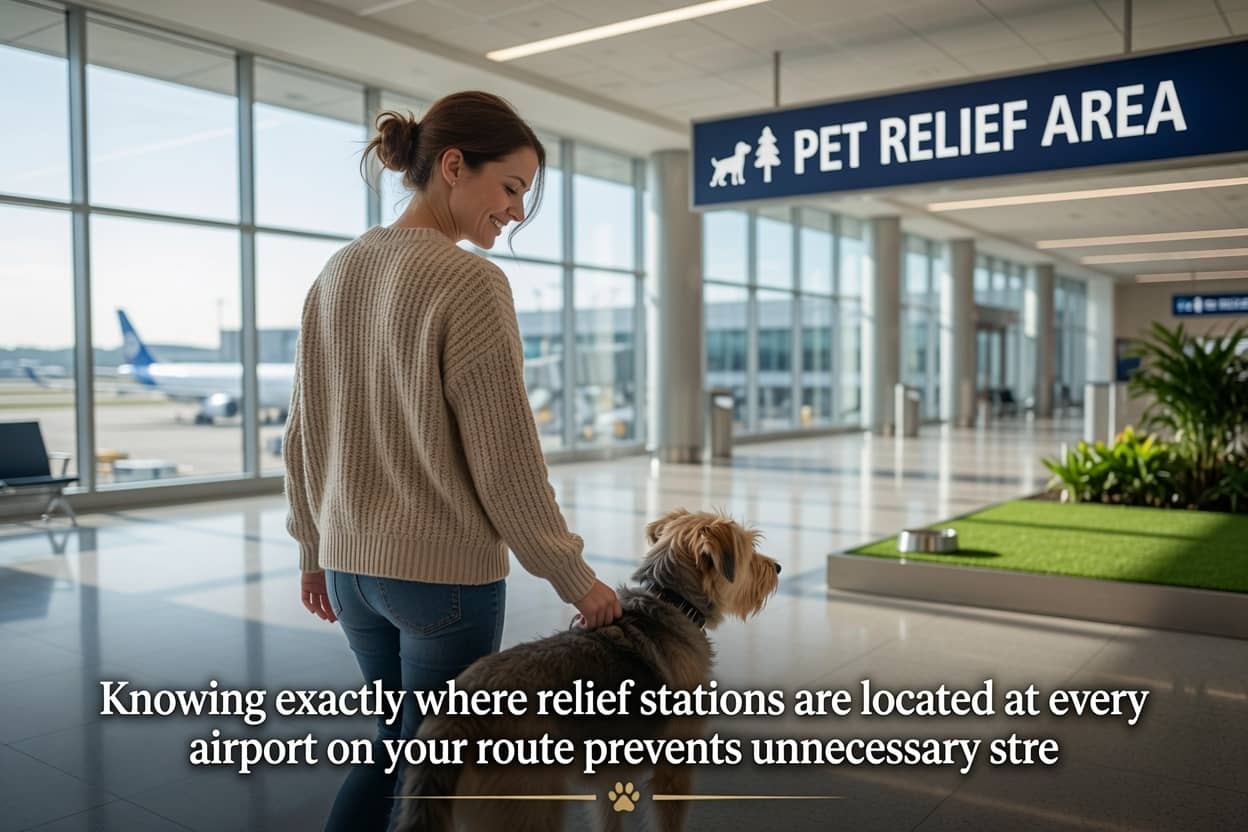
Map your airports in advance. Locate pet relief areas at your departure airport, any connection points, and your destination. Major airports publish maps online; knowing exactly where they are prevents frantic last-minute searches while your dog is already stressed. If your dog is sensitive to new surfaces or sounds, practice walking on different flooring types and hearing airport-like background noise (there are free airport ambience tracks online) during training sessions.
Additional practical steps: Update your dog’s microchip registration and ID tags with current phone numbers. Take clear, recent photos of your dog from multiple angles in case you need to describe them to staff. Prepare a simple travel kit with waste bags, paper towels, a couple of high-value treats, and any prescribed medications in original packaging.
On Travel Day: Airport and Flight Strategies
Give yourself more time than usual — at least two hours for domestic flights and three or more for international. This buffer lets you handle check-in, security, and any unexpected paperwork without rushing your dog.
At security, expect to remove your dog from the carrier while the empty carrier goes through the scanner. Practice this exact sequence at home with a friend or family member playing the role of TSA agent. Keep your own energy calm; dogs mirror our stress levels quickly.
Once onboard (cabin), slide the carrier fully under the seat and resist the urge to check on your dog constantly. A quiet voice or gentle reassurance through the mesh is usually enough. If your dog begins showing strong stress signals (persistent high-pitched whining, heavy panting, or frantic movement), alert a flight attendant rather than trying to open the carrier mid-flight.
For cargo travel, your main influence happens before you hand over the crate. Make sure it is clearly labeled on all sides with your name, phone number, flight details, and “Live Animal” markings. Confirm with the airline whether they provide any updates during ground time. Many owners find that choosing a direct flight, even at a slightly higher fare, dramatically reduces overall stress compared with connections.
Pitfalls to Sidestep When Flying with Your Dog for the First Time
The most common mistake is assuming all airlines operate the same way. What worked for your friend’s dog on one carrier may be completely different on yours. Another frequent issue is skipping carrier training and then being surprised when the dog panics on departure day. Tight connection times are also risky — one delayed inbound flight can cascade into missed connections and extra handling for your pet.
Many first-timers also forget to confirm destination entry rules until they land, only to discover an extra form or vaccine requirement. Over-stuffing the carrier with toys or bedding can actually make dogs more uncomfortable and increase the chance of messes. Finally, some owners choose cargo for a dog who would have been fine in cabin simply because they didn’t measure the carrier against the airline’s under-seat dimensions early enough.
Final Thoughts: Your Dog’s Next Adventure Awaits
Flying with dogs is very doable when you treat preparation as a gradual, positive process rather than a last-minute scramble. Thousands of dogs travel by air every week, and many of them handle it remarkably well once their humans put in the upfront work. Your dog will take cues from you. If you approach the journey with calm confidence and a well-trained carrier routine, your pup is far more likely to stay relaxed too.
Start early, verify everything directly with your airline and destination authorities, and give yourself (and your dog) extra grace on travel day. The memories you’ll make together are worth the effort.
Have you already flown with your dog, or are you planning your first trip? What surprised you most, or what specific worry are you still carrying? Share your experiences or questions in the comments — your story could make the next pet parent’s journey a little smoother. Safe travels to you and your four-legged adventure buddy.
How to Prepare Your Dog for a Long Road Trip


